Before the application existed, creative-economy business data was spread across forms, paper files, and spreadsheet recaps. Updates were hard to track, searches took time, and reports had to be compiled again. Moving everything into an application solved part of the problem. The remaining part was deciding when a record may be seen by the public.
In the creative economy data and directory platform, the answer is simple: data only appears after an administrator has reviewed it.
Data owners submit, administrators review
Creative-economy businesses register their own profiles, products, and documents. They know the details of their business best, so it makes sense for the input to start with them. Administrators do not need to retype everything; their job is to check whether a submission is complete and fit to publish.
This split also removes duplicate work. The same data is no longer written on a form, moved into a spreadsheet, and typed again for a report.
The status decides what is shown
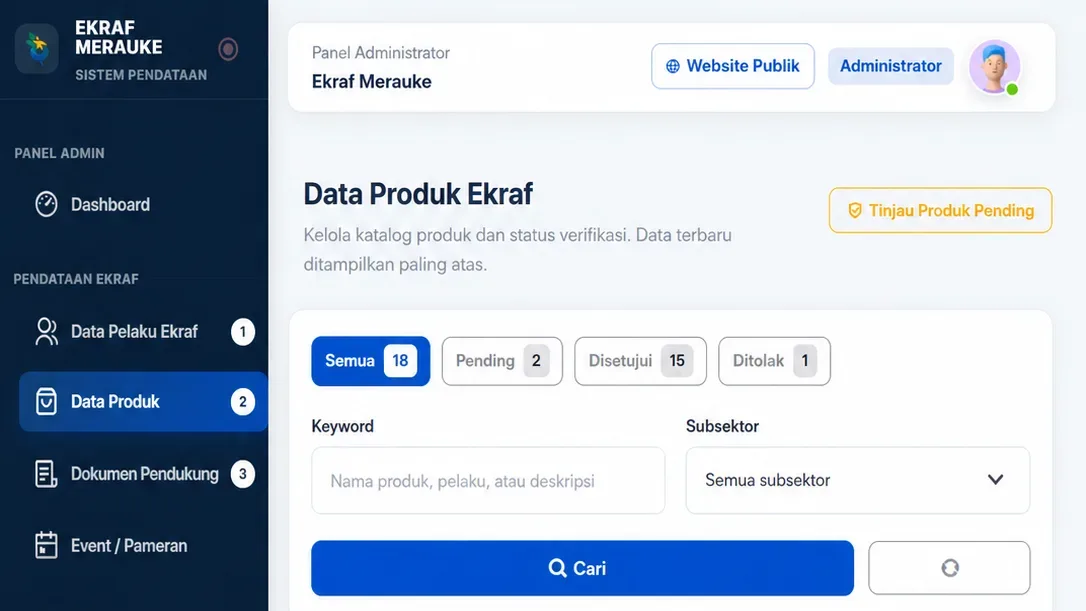
Every submission has a status. Administrators can filter product data by pending, approved, or rejected, and then record the outcome of their review. The public directory only takes approved records. Products that are still pending or were rejected stay in the system but do not appear on the pages visitors read.
Businesses can also follow the status of their own submissions. They do not have to guess whether a product has not been reviewed yet or needs to be corrected.
A public directory is only as good as its data
Visitors can search products and filter them by subsector, business, region, and price range. Filters like these only help when the data behind them is consistent. Reviewing records before publication keeps half-finished entries out of the search results.
It is also a matter of trust. A public directory carries the name of the institution that runs it, so the data it shows needs to be accountable.
Reports read the same data
Management does not need a separate recap. Dashboards and PDF reports read the same business, product, and event data that administrators manage, with filters. For events, the system also prevents duplicate registrations so participant numbers are not inflated.
The full flow, from submission to public directory, is in the creative economy platform case study.